2010/12/21 21:02:28
富士山をプロットする関数をみかけたので、Rで描いてみた。
fx <- function(x){x^4-x^2+6}
sfx <- function(x){12/(abs(x)+1)}
gx <- function(x){1/2*cos(6*x)+7/2}
plot(gx,-2,2,xlim=c(-7,7),ylim=c(0,7),xlab="",ylab="")
par(new=T)
plot(sfx,-7,-1,xlim=c(-7,7),ylim=c(0,7),axes=F,xlab="",ylab="")
par(new=T)
plot(sfx,1,7,xlim=c(-7,7),ylim=c(0,7),axes=F,xlab="",ylab="")
par(new=T)
plot(fx,-1,1,xlim=c(-7,7),ylim=c(0,7),axes=F,xlab="",ylab="")

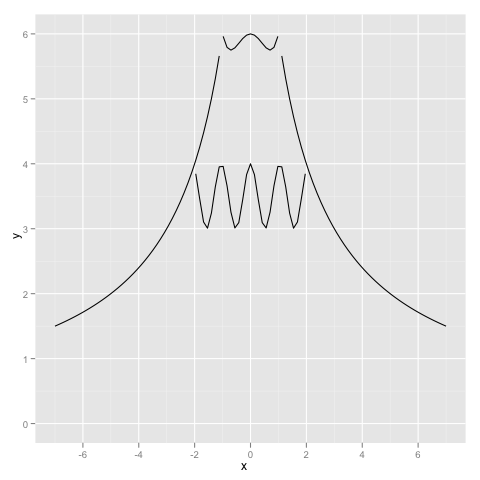
ggplotで関数だけ描く方法わからんなぁとつぶやいたら、教えてもらったのでggplot2でも描いた。
gx <- function(x){
x[-2>x | x>2] <-NA
1/2*cos(6*x)+7/2
}
fx <- function(x){
x[x<(-1)] <- NA
x[x>1] <- NA
x^4-x^2+6
}
fx <- function(x){
x[-1<x & x<1] <-NA
12/(abs(x)+1)
}
ggplot(data.frame(x=c(-7,7),y=0), aes(x,y))+stat_function(fun=gx) \
+stat_function(fun=fx)+stat_function(fun=sx)

ggplot2だと線がうまくつながらなかった。
2010/08/07 10:37:32
昨日の化合物の類似性ネットワークのやつは何がメリットなのかなぁと考えてみたけど、一つにはedgeの数を自由に決められるあたりなんじゃないかと。あんまり低い閾値だとなんでもかんでもつながって何見てるかわからんし、逆に厳しい閾値にしちゃうとシングルトンばかりになっちゃうし。
というわけで、プロット欠かせてそれ見て閾値決める必要はあるんだろうなと。最終的にはeddgesの数とか、ノードあたりに生えているedgeの数の平均とかを統計的に処理して自動で閾値を決めるのが楽なんだろうけど、、、(一般的な方法あるのかな?)。X-meansに倣って、BICとかAIC使ってみようかなぁ。
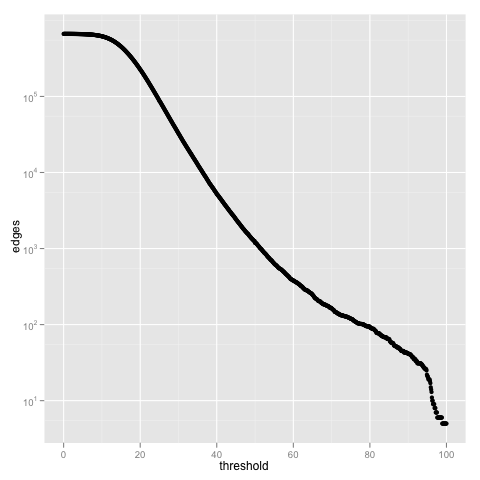
で、プロット描いた。最初に書いたコードがナイーブすぎて遅くていらっときたので書き直した。まだかなり遅いけど、耐えられるのでこれでよしとした。
import pybel
mols = list(pybel.readfile("sdf", "pc_sample.sdf"))
fps = [x.calcfp() for x in mols]
similarity_matrix = []
for i in range(len(fps)):
for j in range(i+1,len(fps)):
similarity = fps[i] | fps[j]
similarity_matrix.append(similarity)
threshold = 0.0
print "threshold\tnodes"
while threshold < 100:
t = threshold / 100.0
new_matrix = [e for e in similarity_matrix if e > t]
nodes = len(new_matrix)
print "%2.1f\t%d" % (threshold, nodes)
similarity_matrix = new_matrix
threshold += 0.1
あとはRで
library(ggplot2)
nodes <- read.table("xxxx",header=T)
qplot(threshold,edgess, data=nodes, log="y")
dev.copy(device=png,filename="xxxxxx")
dev.off()

node数が1158なのでedgeの数が10000から100あたりの間でちょうどいい閾値を探したいんだけど、これだけじゃわからん。やっぱシングルトンの数とかノードあたりに生えているエッジ数の平均とか数えないとだめかな。
2010/03/30 21:44:03
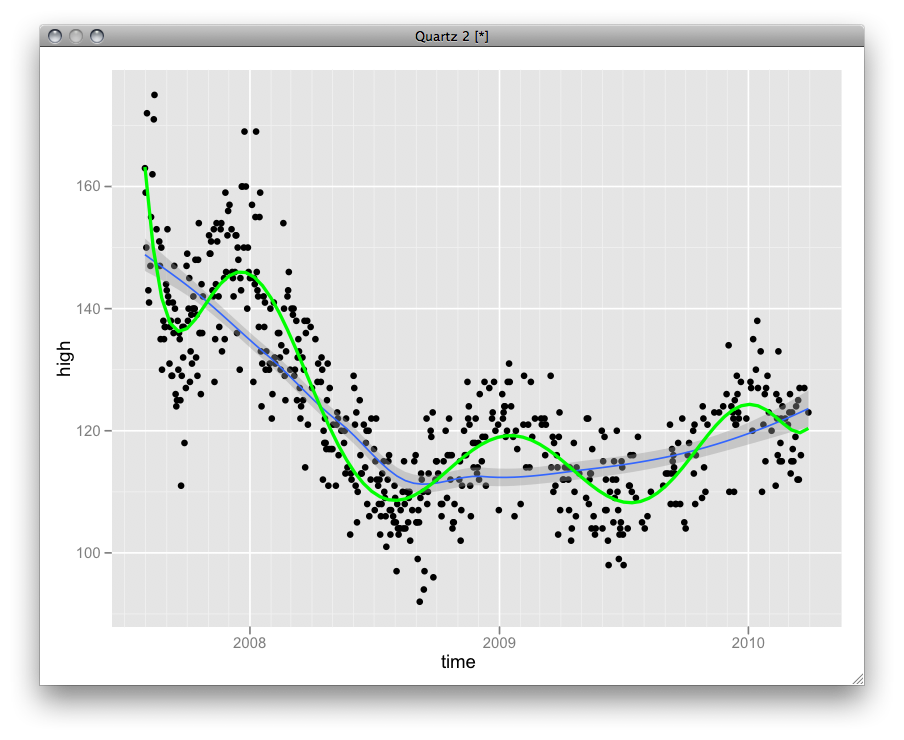
自分の血圧のデータが3年くらい溜まっているので、収縮期血圧と測定日時のプロットをして、スムージングもしてみた。冬場は血圧が上昇する傾向にある。測定始める前は180超えて190近くあったから、かなり落ち着いた感じ。
library(ggplot2)
data <- read.csv("/Users/kzfm/mybp.csv",header=FALSE)
time <- strptime(data$V1, "%Y-%m-%d")
high <- data$V2
low <- data$V3
mybp <- data.frame(time=time,high=high,low=low)
p <- qplot(data=mybp,time,high)
p + stat_smooth() + stat_smooth(colour="green", method="lm", formula=y~poly(x,9), size=1,se=FALSE)

2008年から2009年の頭のあたりで急激に落ちているのは環境要因ですな。そして、ああいう働き方は二度としないしできないだろうなぁ。